
A couple of weeks ago, I fell off the bottom step in my house. Actually, the problem was that I was on the second stair and thought I was on the bottom one. The upshot is that I went down pretty hard … [Read More...]
Welcome
Recent
Can’t Stand the Heat?
In Chinese medicine, there is a condition called Summerheat. It seems appropriate to write about it after we’ve had a string of 90 degree days here in Minnesota in late May and early June. I’ve only experienced Summerheat once, but it was memorable. It happened during my first backpacking trip down into the Grand Canyon one October almost 30 years ago. Our small group of four began hiking down from the North Rim at an elevation of 8,500 feet, and over two days slowly snaked our way down to the Colorado River, losing 6,000 feet of elevation in the process. Over the course of those two days, the scenery and climate changed in a way that’s been compared to hiking from the forests of Canada to the blistering desert landscape of Mexico.
 I held my own for the better part of two days. My pack was heavy, but it was full of water bottles and I was drinking. However, as we got closer to the river it became hot, we were scrambling over large rocks and we had not seen a drop of shade for hours. I thought I was doing okay, but I was hot and working really hard. Fairly late in the afternoon on that second day, we arrived at what can only be described as an oasis; a waterfall that sprang out of the canyon wall, the source of a burbling creek. It was surrounded by scrub and some large trees.
I didn’t realize it, but by that time, damage from the heat had already set in. I had become disoriented and strayed off the trail. While I wasn’t really lost because I could follow the creek, I became separated from my fellow hikers. I plopped into the creek for a few minutes to try to cool off, but I had no idea that I was in trouble. At that point, I was unsure if my friends were in front or behind me on the trail. I pulled myself out of the creek and kept hiking downhill, not sure of where I was going. The trail crossed the creek and forked, which sent me into a panic, but I stayed on the trail that followed the creek downstream—a no-brainer if I hadn’t been heat impaired. I was completely freaked out thinking that I was lost and separated from my group, in the middle of nowhere.
Ultimately, I kept following the creek and came upon one of my friends who had dropped his pack at what would be our camp site for the next couple of days. I had arrived! I sat on a rock, completely exhausted, and in short order I began shivering uncontrollably. Despite the temperature being in the high 80’s, I was freezing cold and would continue to be for the next several hours.
I realize now that what I had was heat exhaustion, and my symptoms were common; I had become disoriented, exhausted, dehydrated and despite being overheated, I had stopped sweating and was really cold. Was what I experienced life-threatening? It’s hard to know, but I realize now that it quickly could have gone bad and turned into an emergency. And it scared me enough that in subsequent trips to the Canyon, I made darn sure it didn’t happen again.
In Chinese medicine, what I experienced is called Summerheat. It’s a pattern of pathogenic heat, of which there are several kinds. You can have heat that causes a fever, hot flashes, flushing and even heat that rises upward and causes migraines. Summerheat is unique in that it’s caused by being exposed to hot weather. Basically, it injures your energy (Qi), exhausts you and dries you out. In humid weather, it can also cause a kind of internal dampness that can upset your digestion and make you feel nauseous and heavy, cause diarrhea, dizziness and irritability.
There is a range of severity and symptoms when it comes to Summerheat. In my case, I became exhausted, confused, dehydrated and intolerant to both more heat and the cold. I was also probably running a fever. Other symptoms that are characteristic of Summerheat include:
- Headaches
- Dizziness
- Irritability
- Thirst
- Heavy sweating or a lack of sweating
- Shortness of breath
- Delirium
- Loss of consciousness
Interestingly, the nature of heat is to rise upward, and with Summerheat, most of the symptoms involve the head or upper body. For me, this was the case as I became disoriented and panicky, and my face became really red, an indication of the heat rising upward in my body. Feeling impossibly cold during that episode was an indication that my internal thermostat had been damaged as well.
So, what can you do for Summerheat? In Chinese medicine, one of the first lines of defense are foods that can cool you off. One of the most effective is watermelon, which 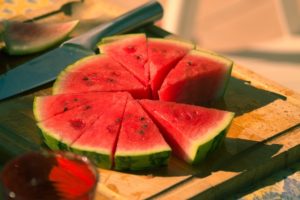 is not only a food, but it’s also classified as a Chinese herb. Full of moisture, sweet and with very cooling properties, watermelon tastes good and clears heat. Not as popular, but just as effective are mung beans. Boil these small dried legumes—about a cup in three cups of water—and drink the water. And while not considered Chinese herbs, drinking fluids that contain electrolytes, such as those found in sports drinks can also help by rehydrating and replacing your body’s minerals lost through heavy sweating.
Acupuncture can also help for episodes of Summerheat. In fact, there are some very specific protocols to clear heat and revive someone with severe symptoms. However, it’s important to know that if your symptoms are severe, such as loss of consciousness, rapid heartbeat, confusion or a throbbing headache, you should seek immediate medical attention as heat-related injuries can be a medical emergency.
There are a few things that you should not do if you’re experiencing Summerheat symptoms. While it may be tempting, avoid eating ice cold foods and drinks. When your body is hot, having something ice cold is really hard on your stomach and doesn’t help to cool you off overall. This is also true for overeating; your stomach can’t handle the stress in the moment. And as you’re rehydrating, drink fluids with electrolytes instead of plain water. The reasoning here is that you’ve already lost electrolytes through sweating. Drinking plain water further dilutes the concentration of your body’s electrolytes and can lead to a condition called hyponatremia, a life-threatening drop in sodium concentration in your cells.
My best advice if you’re having symptoms of Summerheat (that are not life-threatening), is to sit down, take a rest, cool off in the shade and drink to replenish fluids and electrolytes. And eat some watermelon. Which is exactly what I did that afternoon at the bottom of the Grand Canyon, except for the watermelon. I sat on a rock in the shade by the creek, drank Gatorade and soup and added a layer of clothing until I quit shivering. By the next morning I was fine. A day or two later, hiking out of the canyon, I made sure to take my time and rest more often to avoid overheating. While we were battling the heat in the inner canyon, winter happened up top. After a week of hiking, we emerged out of the canyon to ten inches of snow that closed the North Rim for the winter.
Day Tripping: Ten Ways to Avoid Falls
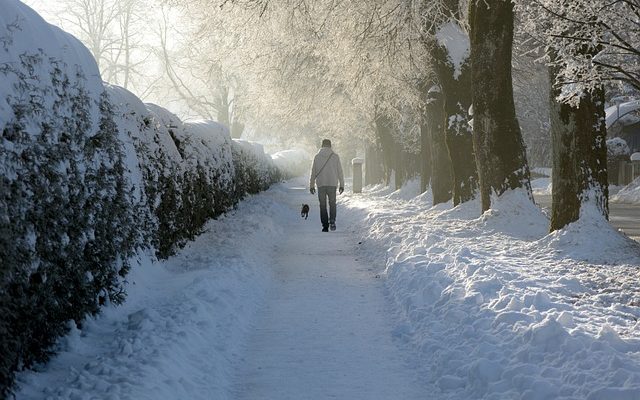
Over the past couple of years, I’ve discovered a new Murphy’s Law. It’s this: The older you are, the worse the outcome tends to be when you fall. Three years ago, I slipped on a patch of snow-dusted ice and broke my elbow. And three weeks ago, I stepped out the front door and fell. It was early in the morning and went out to walk the dog, unaware that we had gotten freezing rain overnight. It was still dark, and I didn’t think twice about the sidewalk because it had been completely clear and dry the night before. My first step out the door took me down, and I landed on the middle of my back. Hard. The good news was that I didn’t hit my head, but the bad news was that I knew I was hurt. An early morning trip to the Emergency Room confirmed that I had fractured a vertebrae in my mid-back. This kind of fracture is a bit like broken ribs; you just have to manage the pain and let it heal. So armed with pain meds, a far-infrared heating pad, A TENS unit and lidocaine patches, I’ve been getting through it.
When it comes to falls, it seems the conversation always turns to the elderly, which is fair because while people of all ages fall and can get hurt, older people break more easily when they go down. That said, both of my falls were righteous hits, no matter my age. Three years ago, as I was being wheeled into the operating room to repair my broken elbow, the 40ish anesthesiologist said to me, “Bummer! I did the exact same thing when I was in high school.” And as I was sitting in the ER after this last fall, I sat next to young people who had also fallen on the ice that morning and broken bones.
So when I talk about fall prevention, I’m speaking to people of all ages while acknowledging that older people may be more prone to falls and fare less well than those who are younger. And with my history I feel like I have some experience when it comes to falls. Here’s my best advice on how to prevent them:
-Don’t get distracted let your guard down, and don’t walk and look at your phone at the same time. Pay attention, especially on sketchy surfaces, 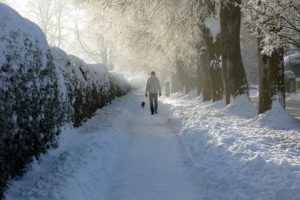 such as snow and ice and those that are uneven, freshly polished, greasy or wet. Had I taken a look at the sidewalk before I stepped out onto the ice, I would have avoided a world of pain, but my mind was on other things.
-Anticipate opportunities for falling and do what you can to offset them. If you live where it freezes in the winter, know that ice or snow is always a hazard and throw down some ice melting agent, kitty litter or sand to improve traction. If you’re navigating a narrow or steep stairway, make sure the light is on and grab the handrail, and go slowly and carefully on sloped or uneven surfaces, such as ramps and sidewalks.
-Reduce risks in your personal space. A great deal of falls occur in and around your home (like me, right off the front step). The good news is that there’s a lot you can do to make your space safer. Reduce the floor clutter in your house, make sure there are no loose rugs or cords that can take you down, and wipe up food and liquid spills in the kitchen. When I was a kid, a single green pea on the kitchen floor took my sister down, resulting in a sprained ankle. Really, it doesn’t take much.
-Your footwear makes a difference, too. Both of my falls could have been avoided had I been wearing ice biters (they’re like thick rubber bands with cleats or coils that attach to the bottom of your shoes). I only buy walking shoes that have no-slip Vibram soles, and after this last fall, I ordered boots with built in ice grippers that lock into place when I need them. If you’re prone to turning your ankles, walking shoes that come up over your ankles can also help decrease your risk.
-Let’s talk about ladders. They’re a great tool, until they’re not. It seems that I’m always hearing about some poor soul who fell off a ladder and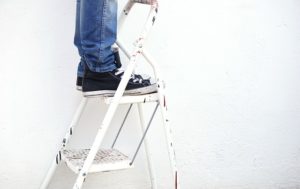 broke bones, hit their head or worse. If you simply must get up on a ladder, make sure the base is on a level surface where it won’t slip or move. Don’t do it solo; make sure you have someone to hold the base of the ladder steady and spot you as you go up and come down. And for Heaven’s sake, have the wisdom to know when you should call a professional to get up on your roof or into that tree with a broken branch. It could save you a world of hurt.
-Think of the dark as a hazard all on its own. Whether you’re getting up in the middle of the night or walking the dog in the dark, the absence of light means that there are many hazards that you won’t see. This includes area rugs, items left on your floor, furniture, uneven surfaces and even your pet. Fixing this is as easy as using the flashlight feature on your phone, adding a nightlight and the awareness that you won’t see what’s going to trip you up in the dark.
 -Don’t be too proud to use handrail, whether it’s on the stairs, in your bathroom or anywhere else. Think of handrails as a secret message that you’re entering a higher risk fall zone.
-Pets can also take you off your feet in a number of ways. They can get underfoot at home, your dog pulling on its leash or simply having to go out and walk Fido on slippery days when you’d normally hunker down indoors. E.g., yours truly at 5 am in the dark after a night of freezing rain—something I would never do if it weren’t for the dog!
-If your balance is sub-par, your risk for falls in greatly increased, but there are ways to improve it. Your balance is controlled through your vestibular system (in your inner ear), your vision and proprioception (your sense of where you are in space) all working together. If you have serious balance problems or vertigo, you can work with a doctor or physical therapist who specializes in dizziness and balance issues. However, a simple fix to strengthen so-so balance is to stand on one foot (with a chair, wall or countertop nearby if needed for support). Begin with ten seconds balancing on each foot, working up to 30 seconds and then a minute.
-Finally, keep your cell phone with you when you’re out walking, and nearby when you’re at home. Both times I fell, I was lucky enough to have my phone in my pocket and was able to call a family member to help me. It has now become a personal rule, even when I’m just taking the dog out for a very quick trip.
The bottom line is that falls happen. I have been vigilant all winter, assessing the snow and ice in my neighborhood. However, all it takes is one second of letting your guard down at the wrong time and in the wrong place. The good news is that there some pretty simple things you can do to increase your awareness and lower your risk. Take it from me; an expert on falling!
Articles

Don’t Throw My Groceries
Not long ago, during a weekly grocery shopping trip, I had a weird thing happen. At the end of the trip in the checkout line, the cashier tossed my groceries toward me as I bagged. Sack of onions; … [Read More...]

Purely for Yourself
In my spare time I like to take pictures. Not just any pictures, but mostly outdoor scenes from nature and awe-inspiring landscapes. I recently bought a new camera and have spent several months … [Read More...]

Your Connection to Nature
I grew up in New England, on a bluff overlooking the Connecticut River. We lived in a quiet town with a village green, a local dairy around the corner, and houses lining Main Street that were built in … [Read More...]
How to Keep Moving as You Age
In the news this week was a story about a recent study on balance and your health. Researchers asked participants between the ages of 51 and 75 to balance on one leg for ten seconds with their head up … [Read More...]
Introverts and Energy
The world is made up of introverts, extroverts and people that fall someplace in between. For some, being one or another doesn’t make a big difference in their lives. However, for introverts like me, … [Read More...]